
How Marx’s Theory of the "Commons" Explains the AI Crisis

The more I think about it, I am convinced AI has a communism problem. In this post lets explore Karl Marx’s theories on the commons and how I think they map to the current AI discourse.
Karl Marx viewed the “commons”, the land, forests, and waters held in common by villagers for centuries as the site of a foundational tragedy that birthed capitalism.
His analysis of the commons spans his entire career, from his early journalistic defense of peasants’ rights to his late-stage technical analysis of “Primitive Accumulation.”
1. The Early “Theft of Wood” Debates
Marx’s first serious engagement with economics occurred in 1842, when he wrote about the Debates on the Law on Thefts of Wood. The provincial government in the Rhineland had begun criminalizing the gathering of fallen wood in forests, a “customary right” the poor had exercised for generations.
Marx argued that:
Custom vs. Law: The state was transforming an ancient, communal “use-right” into a crime to protect the “private property” of landowners.
The Privatization of Nature: For the first time, Marx saw how the law was being used to “fence off” nature from the people, turning a common resource into a commodity for sale.
2. “So-Called Primitive Accumulation”
In Capital, Volume 1, Marx explains how the commons were destroyed to create the modern world. He called this process Primitive Accumulation (or ursprüngliche Akkumulation).
To Marx, capitalism could not begin until two things existed: a pool of wealth in a few hands and a mass of people with nothing to sell but their labor. He argued the second part was achieved by forcibly stealing the commons.
The Enclosure Movement: In England, landlords used “Enclosure Acts” to fence off common lands (fields, meadows, and forests).
The Creation of the Proletariat: Once the peasants lost access to the commons, they could no longer feed themselves. They were “set free” from the land—meaning they were forced into cities to work in factories for wages.
State Violence: Marx famously noted that this history “is written in the annals of mankind in letters of blood and fire,” highlighting that the commons weren’t “traded” away; they were taken by force.
3. The “Metabolic Rift”
Marx also looked at the commons through an ecological lens. He argued that when people were separated from the land (the commons), it created a metabolic rift.
In the old common-field system, nutrients from the soil stayed local.
In the new capitalist system, food was shipped to distant cities. The “waste” (human excrement) polluted the cities instead of being returned to the soil as fertilizer, leading to the depletion of the earth’s fertility.
4. The “Negation of the Negation”
Marx did not want to simply “go back” to the medieval commons. Instead, he envisioned a future where society reached a higher form of communal ownership.
He described this as the “Negation of the Negation”:
First State: Individual private property based on one’s own labor (small-scale farming/crafting).
The Negation: Capitalism destroys that small-scale property and the commons, concentrating everything into a few private hands.
The Negation of the Negation: A future socialist society that restores “individual property” but on the basis of “possession in common of the land and the means of production.”
Summary: For Marx, the “commons” represented a lost unity between humans and nature. Their destruction was the “original sin” of capitalism, and their restoration (in a modern, industrial form) was the ultimate goal of communism.
Now that you have read about the summary of Marx’s theories on the commons, if you have anything to do with AI you immediately know how all of the above maps to the Internet and the AI mega corps and the governments. All you need to know is that in our digital age, it’s the Internet which is the commons. But just for the sake of clarity let me lay out the mapping clearly.
Here is how Marx’s critique of the commons maps onto the transition from the Open Internet to the AI Era:
1. Data Scraping as “Primitive Accumulation”
Marx argued that capitalism didn’t start with honest trade, but with theft. He called the seizure of communal land “Primitive Accumulation.”
In the digital context:
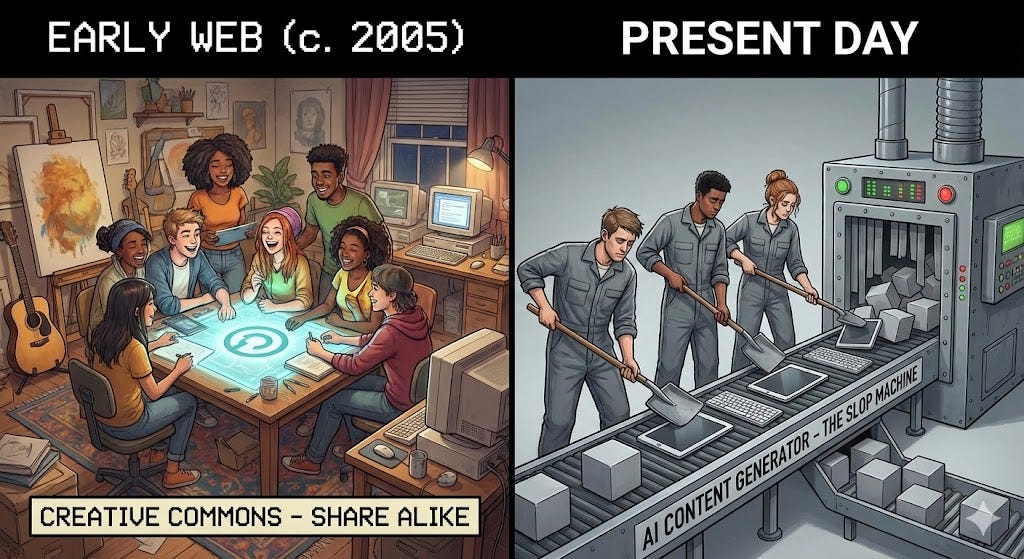
The “Commons”: For 30 years, humans built the internet: Wikipedia, Reddit, open-source code (GitHub), personal blogs, and art portfolios, largely for the sake of sharing, community, and “use-value.”
The “Enclosure”: First we had the social media companies like Meta, Twitter, LinkedIn create walled gardens. That itself was a huge issue for the open Internet. But now, the AI companies have used web-crawlers to “fence off” this collective human knowledge. By ingesting this data into private, proprietary models, they have transformed a public resource (the open web) into private capital.
The “Original Sin”: Just as the peasants didn’t consent to their land being fenced, the creators of the internet didn’t “consent” to their life’s work being used to train a commercial product that might eventually replace them.
2. Creating the “Digital Proletariat”
Marx’s central thesis on the commons was that once people lost access to the land, they were forced to sell their labor to the very people who took it.
Loss of Independence: A writer or artist previously “owned” their means of production (their talent and a platform). They could reach an audience directly on the “commons” of the internet. (Of course, we can say the creators are not really independent even now what with Google, Youtube, Meta, Spotify controlling the distribution. But that’s a different fight :) )
The Shift: Now, as AI-generated content floods the market, the value of human labor is being driven down. Many creators find themselves in a position where they must either work for the AI (as data labelers or “prompt engineers”) or compete against a machine trained on their own past work.
Alienation: The worker is now “alienated” from their product. The worker now creates content only for the AI machine. Your data is used to build a model that you then have to pay a subscription fee to use.
3. Regulatory Capture: The New “Enclosure Acts”
In the 1800s, the British Parliament passed “Enclosure Acts”—laws that legally sanctioned the theft of the commons.
Today, we see a similar pattern in AI Policy and Lobbying:
The “Moat”: Established AI giants are now calling for heavy regulation and licensing. While framed as “safety,” critics would argue this is a way to ensure that only the wealthiest companies can afford to operate.
Legalizing the Theft: Once the data has already been scraped (the “accumulation” phase), these companies seek laws that protect their models while making it harder for new, open-source, or smaller competitors to catch up.
4. The “Metabolic Rift” of Information
Marx’s idea of the Metabolic Rift (where the soil is depleted because nutrients aren’t returned) is particularly relevant here.
If AI “scrapes” the internet but doesn’t “feed” it back, meaning, if AI kills off the blogs, forums, and journalism that provide the original data, the “digital soil” becomes sterile.
The “Dead” Internet: If human creators stop posting because they aren’t being paid or recognized, AI will eventually start training on its own output (Model Collapse).
The Crisis: This mirrors Marx’s warning about capitalism’s tendency to exhaust the very two sources of all wealth: the earth and the laborer.
Summary: Some have called this “Data Colonialism.” The internet was a communal “forest” where we all gathered. AI companies have cut down the trees to build a factory, and are now charging us for the wooden chairs they made from our own timber.
Disclaimer: I am not an expert on communism or Karl Marx. What I know is from my discussions with friends and family and my understanding of commons and communism.