
OpenAI's VC question: What if Google copies you?
OpenAI is officially facing the VC question that every startup faces: What if Google copies you?

And honestly, the prognosis doesn’t look good for OpenAI.
For two glorious years, OpenAI was the shiny, disruptive upstart, forcing the $2 trillion giant to panic. Now, the tables have turned so dramatically, it’s less a competitive reversal and more a full-scale corporate comedy of errors starring a non-technical CEO and a giant, insatiable financial black hole.
The Irony is Now a Circular Firing Squad
We all remember December 2022. Google CEO Sundar Pichai reportedly declared a “Code Red” after ChatGPT landed like a meteor in Mountain View, threatening the core Search business.
Fast forward. The Search results confirm that this time, the crimson alert flashed in San Francisco. OpenAI CEO Sam Altman, in an internal memo, has now declared a “Code Red.”
The reason? Google’s Gemini 3.
As Marc Benioff wrote publicly after testing the rival model: “I’m not going back. The leap is insane – reasoning, speed, images, video everything is sharper and faster. It feels like the world just changed, again.”
I know Marc has been tweeting like an AI influencer for a long time now, just like Reid Hoffman, but seriously.
Wow!
The Gorilla vs. The Cheerleader
Google’s move to simplify its fractured AI efforts—finally managing to get all its AI chatbots collapsed into one name, Gemini—signals a pivot from distraction to execution. With its own TPUs, deep integration into Search and Android, and a $100+ billion cash pile, Google is the ultimate full-stack Gorilla.
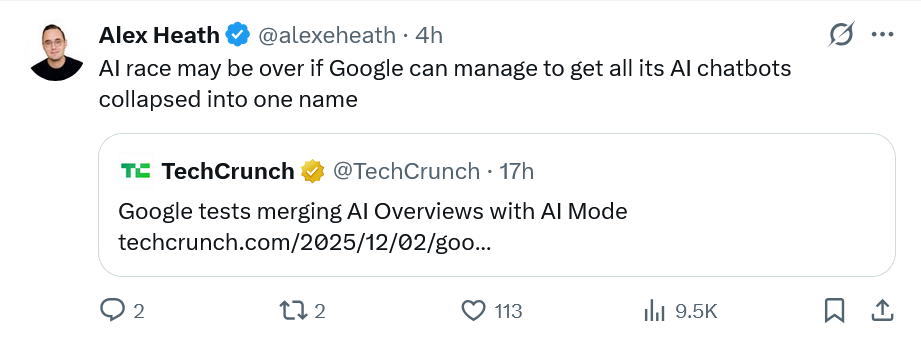
And Sam Altman? He’s the ultimate financier. He is great at talking, selling, and recruiting capital, but in this specific technical crisis, the difference a technical founder makes becomes glaringly obvious.
The hard truth is: Sama cannot do anything here. He cannot even inspire. He can raise money, yes, but he is playing with Gorillas who have a lot more money. And clout.
Sam Altman cannot do anything other than declare a code red.
The Futile Battle Plan
Altman’s internal memo laid out the revised plan: to allocate more resources to improving ChatGPT. But I don’t think resources are the problem for ChatGPT. Direction is the problem.
The problem is that none of the priorities mentioned below will make any dent in Google’s fundamental advantage:
The plan is to allocate more resources to improving ChatGPT, with teams concentrating on features that allow more personalized interaction with ChatGPT.
Other core priorities include:
advancing the image-generation model Imagegen,
improving model behavior,
strengthening leaderboard competitiveness with systems like LM Arena,
enhancing ChatGPT’s speed and stability,
reducing unnecessary refusals to harmless questions.
Just go through the list above. Who has asked for any of these? How can they make money with any of these? And why can’t Google do a better job at these?
OpenAI is trying to iterate its way out of an infrastructure war. It’s like challenging an aircraft carrier to a boxing match.
The new plan of ads to get revenue will just kill the golden goose. ChatGPT will become AdGPT.
The Loss-Making Monster
The final, terrifying truth for investors is the economics. OpenAI is a loss-making monster.
The cost of chasing AGI is so staggering that even if the company achieves aggressive revenue targets, it will still drown in debt. New analysis projects that even IF it can hit $200bn revenue by 2030, it’ll still need over $200bn in funding just to stay afloat.
As an HSBC estimate noted, OpenAI needs to raise at least $207 billion by 2030 just to cover its massive compute commitments, a hole one analyst called a “dot-com on steroids.”
This isn’t a sustainable business model; it’s a government-backed R&D project being accidentally run by a startup.
The conclusion is inescapable, harsh, and realistic: It’s plain and simple. The world doesn’t need OpenAI.
The AI technology will continue to advance. The models, the chips, and the capabilities are now too decentralized and too important to rely on one hyper-leveraged startup. AI will survive and in fact will become better without OpenAI. It just won’t have the same high-burn rate.