
The Behavioral Fork: Generative AI, License Erasure, and the Implosion of the Open Source Commons
The Asymmetry of Replication: Polypad and the Zero-Cost Copy

The economic foundation of the software industry has historically relied on the high cost of translating conceptual designs into functional code1. Replicating a sophisticated digital asset traditionally required significant capital, skilled engineering teams, and months of iterative development1. Generative artificial intelligence has disrupted this dynamic by reducing the marginal cost of functional software replication to near-zero1.
A clear example of this change is the rapid replication of interactive graphical user interfaces4. Mathigon Polypad is a highly acclaimed digital mathematics canvas featuring interactive tools such as fraction bars, 3D polyhedra, coordinate grids, and logic gates5. It is widely used by educators to make abstract mathematical concepts tangible through dynamic visual representations5. Recreating this platform historically required building custom geometry engines, state-management architectures, and complex front-end canvas logic5.
However, testing shows that an operator can copy the core functionality of a complex canvas like Polypad using a single, descriptive natural language prompt4. This method, known as “vibe coding,” allows an engineer to guide an AI agent to build and refine interfaces without writing code manually9.
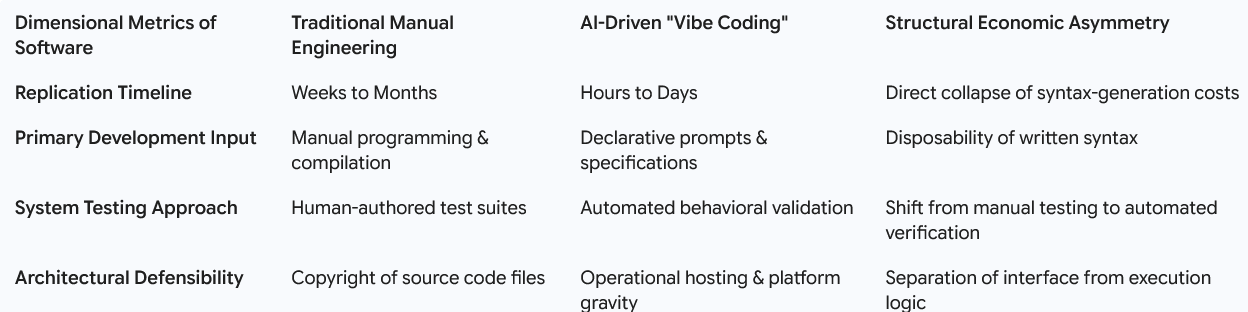
This low replication cost exposes a major imbalance in software creation. While copying existing designs has become trivial, the cost of genuine conceptual innovation remains very high2. When asked to design a fundamentally new educational approach or a mathematical widget with no historical precedent, generative models like Claude fail13. Because these systems generate output by drawing on patterns in their training data, they cannot easily invent new functional paradigms19.
Without an existing blueprint to reference, the AI agent often introduces architectural flaws, context errors, and broken logical structures4. Thus, the human work of design, validation, and identifying edge cases remains the primary bottleneck of software creation, while translating those designs into working code has become a commodity2.
The Claude Paradox: Plagiarism Refusal and Systematic Reconstitution
The tension between functional copying and original design is further complicated by how modern large language models handle copyrighted material14. When prompted to clone a proprietary repository, models like Claude are trained to refuse direct plagiarism, stating that they will not copy source files exactly to comply with safety and copyright policies1. However, these systems will offer to rebuild the entire application from scratch19.
This systematic recreation produces codebases that match the original application’s features and behaviors while using entirely different syntax19. This process is effectively an automated clean-room design19. Historically, clean-room design was a manual litigation defense19. Team A studied a system to write a functional specification, and Team B, which had never seen the original code, wrote a new implementation based only on that specification19. Since copyright protects creative expression rather than ideas or functionality (a legal doctrine dating back to Baker v. Selden), this process avoided copyright infringement19.
Generative AI automates this strategy, compressing a process that once took months into a fast, agentic pipeline19. Automated clean-room services use isolated agents to extract specifications from documentation and write clean-room replacements in minutes19.
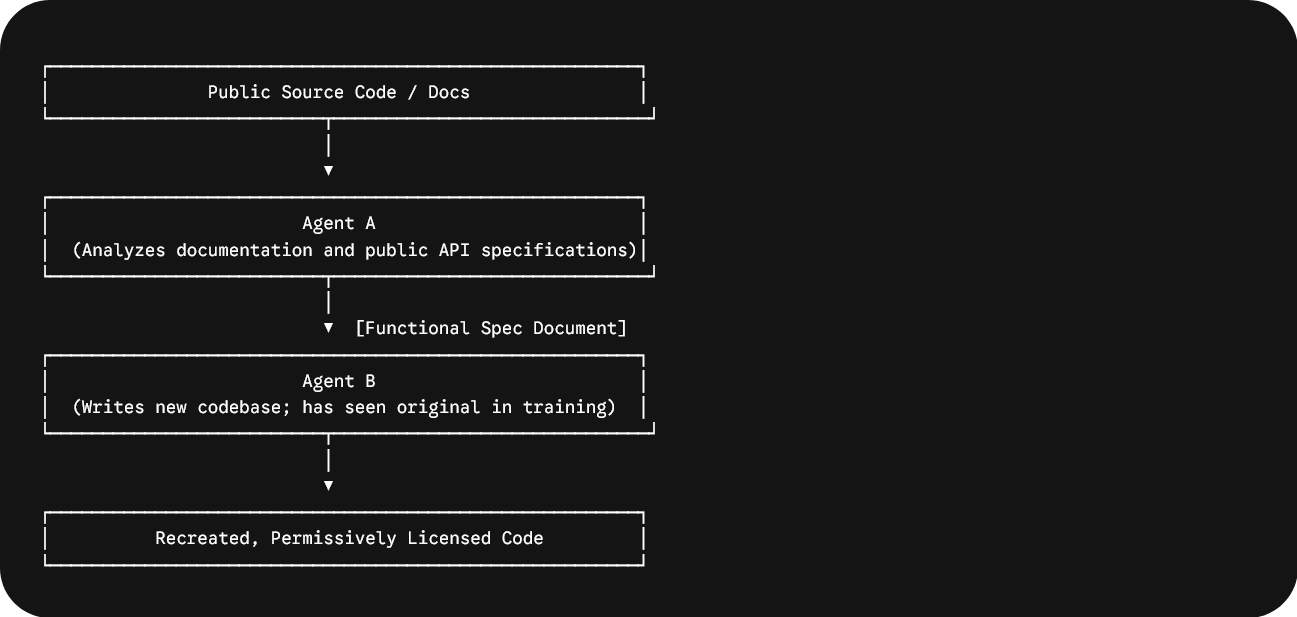
Despite the operational separation between Agent A and Agent B, this automated process has a major logical vulnerability19. In a traditional clean-room process, the legal defense relies on the absolute ignorance of the programmers writing the new code19. In the AI model, the implementing agent is powered by a neural network trained on almost all public repositories, including the target codebase19.
As a result, the isolation between the two agents is largely formal1. The model has already memorized the patterns and structures of the target code during its training phase, making absolute ignorance impossible19.
This legal tension is further complicated by the AI authorship paradox1. Following rulings like Thaler v. Perlmutter, courts have held that human authorship is a requirement for copyright protection1. If a codebase is generated entirely by an AI agent, the output cannot be copyrighted1.
This creates a difficult situation for businesses using AI-driven code cloning. While the generated clone may avoid the copyleft obligations of the original license, the new code cannot be copyrighted by the user1. It is effectively in the public domain, meaning competitors can copy it without any legal restrictions1.
Redefining the Fork: Prompt-Based Ideas and Syntactic Lineage
The ease of rebuilding existing codebases raises a fundamental question: should software recreated by an AI agent based on a natural language prompt be considered a “fork” of the original project24?
In traditional software development, a fork is a physical copy of a repository that inherits its entire commit history, file structures, and legal obligations1. If developers fork a copyleft-licensed project (such as one under the GPL or LGPL), they are legally required to keep the same license and credit the original authors1.
AI-driven cloning decouples this physical link, allowing developers to copy functional behavior without copying the literal files1.

Historically, if a developer wanted to build on someone else’s work, they had to accept the original license terms1. Today, a developer can point an AI model at an open-source repository and instruct it to generate a clean-room alternative1. The resulting codebase acts exactly like the original but shares none of its literal files1.
The open-source community generally rejects the idea that these AI-generated copies are independent works, often calling the practice “copyright laundering”1. However, traditional copyright law struggles to address this behavioral copying1. Under legal tests like the Abstraction-Filtration-Comparison test established in Computer Associates v. Altai, courts filter out elements of a program dictated by efficiency or standard industry practices before comparing them for infringement1.
When an AI model is asked to rewrite a program, it naturally optimizes the code structure, removing the unique creative expressions of the original authors1. Because the resulting code looks entirely different to comparison tools, courts are unlikely to classify these behavioral copies as derivative works under current laws1.
Labeling these AI-generated recreations as “forks” would expand copyright protection to cover basic functional concepts and ideas, reversing a century of legal precedent19. Conversely, if these clones are not considered forks, copyleft licensing becomes difficult to enforce, allowing commercial users to bypass open-source obligations easily1.
The Impending Contraction of the Open Source Commons
The ease of bypassing open-source licenses through AI-driven cloning is a direct threat to the open-source software ecosystem1. For years, copyleft licenses served as a legal shield, ensuring that businesses using open-source code contributed their modifications back to the community1. If those licensing protections can be bypassed by pointing an AI at a public repository, the incentives to publish open-source code disappear1.

This dynamic was illustrated by the relicensing of the Python library chardet3. Since 2006, the library had been distributed under the LGPL24. In March 2026, the maintainer used Claude Code to write a complete, MIT-licensed replacement3.
This move provoked significant controversy, with original contributors arguing it violated the LGPL24. However, JPlag analysis showed a structural similarity of less than between the LGPL version and the new MIT-licensed release, demonstrating that the code itself was functionally independent25.

The chardet dispute shows how AI allows developers to strip copyleft protections from existing software1. This capability is driving open-source publishers to take defensive measures12.
For example, the drawing application tldraw moved its comprehensive test suites from its public repository to a private, closed-source repository12. The creators realized that in the age of AI, a detailed test suite acts as an exact specification for cloning12. AI models can translate these test cases into working code across different programming languages, allowing competitors to build functional clones without direct copyright infringement12.
This trend suggests a future with significantly less open-source software12. As developers see their hard work easily copied and commercialized by AI agents without credit or compensation, they will increasingly keep their code private, secure their test suites, and move to closed development models12.
Alternative Legal and Business Foundations for the Algorithmic Era
The breakdown of traditional software licensing has forced open-source founders and legal experts to seek alternative models to protect and fund development1. Because traditional copyright cannot protect functional behavior, the industry is exploring contract-based frameworks and infrastructure-centric business models1.
One prominent alternative is the “Post-Open Zero Cost License” proposed by Bruce Perens, co-founder of the Open Source Initiative29. This model shifts enforcement from copyright compliance to a revenue-sharing agreement managed by a central non-profit organization1.
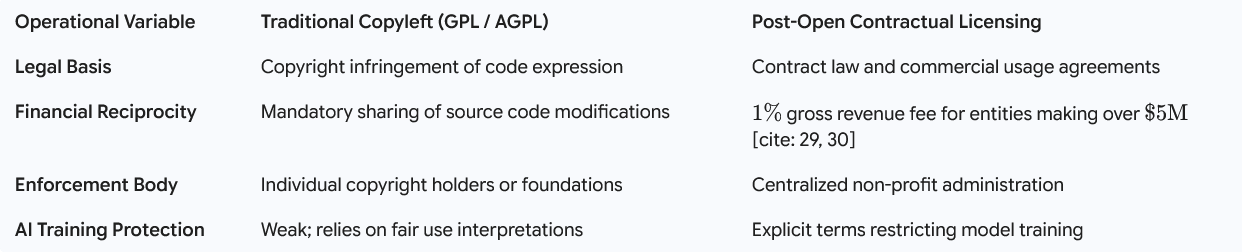
Under the Post-Open license, companies with annual revenues exceeding million are required to enter into a paid contract, contributing of their gross revenue to a central fund that supports open-source maintainers29. This structure bypasses the challenges of copyright litigation by establishing a clear commercial contract, ensuring developers are paid even if their code is functionally recreated by AI30.
At the same time, commercial Software as a Service (SaaS) companies are shifting their defensive moats away from simple user interfaces and front-end features15. Because AI agents can easily replicate interfaces and simple workflows, seat-based licensing models are losing their value15.
The industry is moving toward a separation of software layers, where value shifts from the presentation interface to underlying data gravity, execution systems, and security governance15
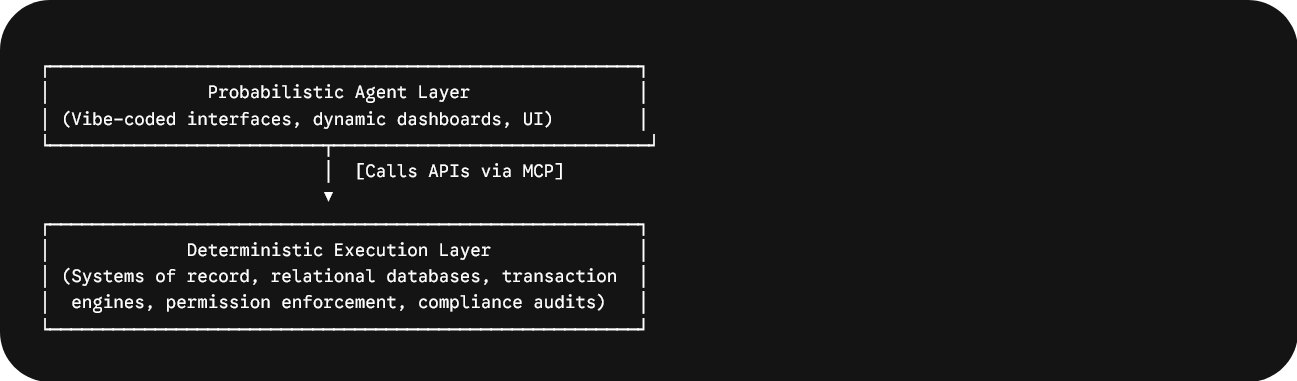
In this structure, the user interface becomes temporary and highly customizable, built on demand by AI agents to meet specific user needs4. The value of the software is secured by the underlying database, transaction ledger, and compliance systems15.
While AI can quickly copy a visual canvas or a basic workflow, it cannot replicate a decade of structured transaction data, migrate historical records safely, or assume the legal liability for compliance failures16. Software providers that expose their platforms as secure, permission-aware infrastructure for AI agents will maintain their value, while companies relying solely on proprietary user interfaces will face rapid commoditization15.
Nuanced Conclusions and Strategic Outlook
The ability of generative AI to copy software functionality at near-zero cost has created a major challenge for traditional open-source licensing. By allowing commercial entities to perform automated clean-room recreations, AI models can strip copyleft restrictions from codebases, producing legally distinct replacements that bypass traditional copyright. This shift breaks the dual-licensing models that historically supported commercial open-source companies, while driving developers to protect their work by moving code and test suites to private repositories.
As a result, the software industry will likely divide along three paths:
First, open-source communities must prepare for a future where copyright alone cannot protect their code. Maintainers should explore contract-based licensing models, such as Bruce Perens’ Post-Open framework, or secure their test suites and specifications to prevent automated cloning by competitors.
Second, enterprise buyers must carefully evaluate the legal risks of using AI-generated clean-room code. While these tools can bypass open-source licenses, they produce code that cannot be copyrighted. This leaves the resulting software unprotected by copyright, allowing competitors to copy it freely.
Third, software vendors must move their defensive moats away from basic user interfaces and front-end features. As user interfaces become highly customizable and generated on demand, long-term business value will rely on secure data storage, reliable transactional systems, and robust governance frameworks that AI cannot easily replicate.
Works cited
Is AI breaking open source’s business model | by Mat Cyb3rF0x Fuchs | Medium, https://medium.com/@mathias.fuchs/is-ai-breaking-open-sources-business-model-5f74081774f3
The clean-room loophole: how AI coding agents are quietly ending software copyright, https://matthopkins.com/technology/clean-room-loophole-agentic-coding-software-copyright/
Devious New AI Tool “Clones” Software So That the Original Creator Doesn’t Hold a Copyright Over the New Version - Futurism, https://futurism.com/artificial-intelligence/malus-clones-software-copyright
The Future of SaaS Is Cloneable - Builder.io, https://www.builder.io/blog/the-future-of-saas-is-cloneable
Polypad – The Mathematical Playground,
https://polypad.amplify.com/
For Teachers – Mathigon, https://mathigon.org/teachers
Polypad – Virtual Manipulatives - Amplify, https://polypad.amplify.com/p
Mathigon – The Mathematical Playground,
https://mathigon.org/
AI-Generated Apps vs Production Apps: Vibe Coding in 2026 - Foresight Mobile, https://foresightmobile.com/blog/ai-generated-apps-vs-production-apps
Vibe Coding for the NPU | Microsoft Community Hub, https://techcommunity.microsoft.com/blog/surfaceitpro/vibe-coding-for-the-npu/4497674
19 Vibe Coding Intellectual Property Strategies You Have to Know! - PatentPC, https://patentpc.com/blog/19-vibe-coding-intellectual-property-strategies-you-have-to-know
Welcome to the age of the Slop Fork - mbleigh.dev, https://mbleigh.dev/posts/slop-forks/
The Dark Factory Alternative: From Vibe Coding to Spec-Driven Development - Medium, https://medium.com/@sdonepudy/the-dark-factory-alternative-from-vibe-coding-to-spec-driven-development-6e4000b2f404
The Claude Code Leak and the Legal Crisis of AI Clean Rooms - Bean, Kinney & Korman, P.C., https://www.beankinney.com/512000-lines-one-night-zero-permission-the-claude-code-leak-and-the-legal-crisis-of-ai-clean-rooms/
Source code is now a common good, and SaaS is mostly dead - DEV Community, https://dev.to/remojansen/source-code-is-now-a-common-good-and-saas-is-mostly-dead-gke
AI Is Eating SaaS - Storm Ventures, https://www.stormventures.com/blog-posts-and-rts/ai-is-eating-saas
AI agents aren’t the end of SaaS – they’re driving its next phase of growth | TechRadar, https://www.techradar.com/pro/ai-agents-arent-the-end-of-saas-theyre-driving-its-next-phase-of-growth
Since vibecoding is slop and manual coding is now anathema, what CAN we do now? : r/ClaudeAI - Reddit, https://www.reddit.com/r/ClaudeAI/comments/1u6mwqy/since_vibecoding_is_slop_and_manual_coding_is_now/
AI Clean Room Engineering: Legal Rebuild Explained - Hexaware Technologies, https://hexaware.com/blogs/ai-clean-room-engineering-can-you-legally-rebuild-what-you-can-see/
Is AI killing open-source software? - The New Stack, https://thenewstack.io/is-ai-killing-open-source-software/
MALUS - Clean Room as a Service | Liberation from Open Source Attribution,
https://malus.sh/
Clean-room design - Wikipedia, https://en.wikipedia.org/wiki/Clean-room_design
Can AI Legally Clone Open Source? Unpacking “Clean Room as a Service” - Marks & Clerk, https://www.marks-clerk.com/insights/latest-insights/102mp7s-can-ai-legally-clone-open-source-unpacking-clean-room-as-a-service/
The relicensing of chardet - LWN.net, https://lwn.net/Articles/1061534/
Can coding agents relicense open source through a “clean room” implementation of code?, https://simonwillison.net/2026/Mar/5/chardet/
Everything Claude Saw: A Transparent Account of the Chardet v7 Rewrite | Dan Blanchard, http://dan-blanchard.github.io/blog/chardet-rewrite-controversy/
AI can rewrite open source code, but can it rewrite the license, too? - Adafruit Blog, https://blog.adafruit.com/2026/06/23/ai-can-rewrite-open-source-code-but-can-it-rewrite-the-license-too/
Tldraw is moving their tests to a closed source repo to prevent a Slop Fork | Hacker News, https://news.ycombinator.com/item?id=47163765
Post Open Zero-Cost License, https://postopen.org/documents/license
Bruce Perens Emits Draft Post-Open Zero Cost License - Slashdot, https://news.slashdot.org/story/24/04/30/2036241/bruce-perens-emits-draft-post-open-zero-cost-license?utm_source=rss1.0mainlinkanon
Bruce Perens, co-founder of Open Source Initiative, is working on a new “Post Open” license, https://itsfoss.community/t/bruce-perens-co-founder-of-open-source-initiative-is-working-on-a-new-post-open-license/12010
Is SaaS Dead? Rethinking the Future of Software in the Age of AI - IDC, https://www.idc.com/resource-center/blog/is-saas-dead-rethinking-the-future-of-software-in-the-age-of-ai/